TL;DR:
DuploCloud’s Kubernetes Agent automates day-to-day cluster operations through approval-gated execution, short-lived scoped credentials, and complete audit trails.
Proven impact: Platform teams using DuploCloud’s Kubernetes Agent have reduced mean time to recovery (MTTR) for common incidents from 45 minutes to under 5 minutes while eliminating repetitive kubectl work that previously consumed 70% of engineering cycles.
DuploCloud’s Kubernetes Agent handles:
- Automated troubleshooting and incident detection
- Pod failures and resource scaling
- Environment provisioning
- Runbook standardization
Your team gains faster incident response and reduced operational toil without requiring deep Kubernetes expertise.
Find out more in this article, and try it now.
The Problem: Kubernetes Work Overwhelms Platform Teams
Platform engineers spend 70% of their time on repetitive Kubernetes tasks. In most cases, this involves restarting crashed pods, scaling deployments, checking resource limits. Because of this, strategic work stalls.
Every crashloop, OOM kill, and “can you check my pods?” request pulls skilled engineers away from platform improvement. This creates a cycle where the DevOps burden grows faster than team capacity and on-call engineers burn out debugging the same patterns over and over again.
How Our Kubernetes Agent Works
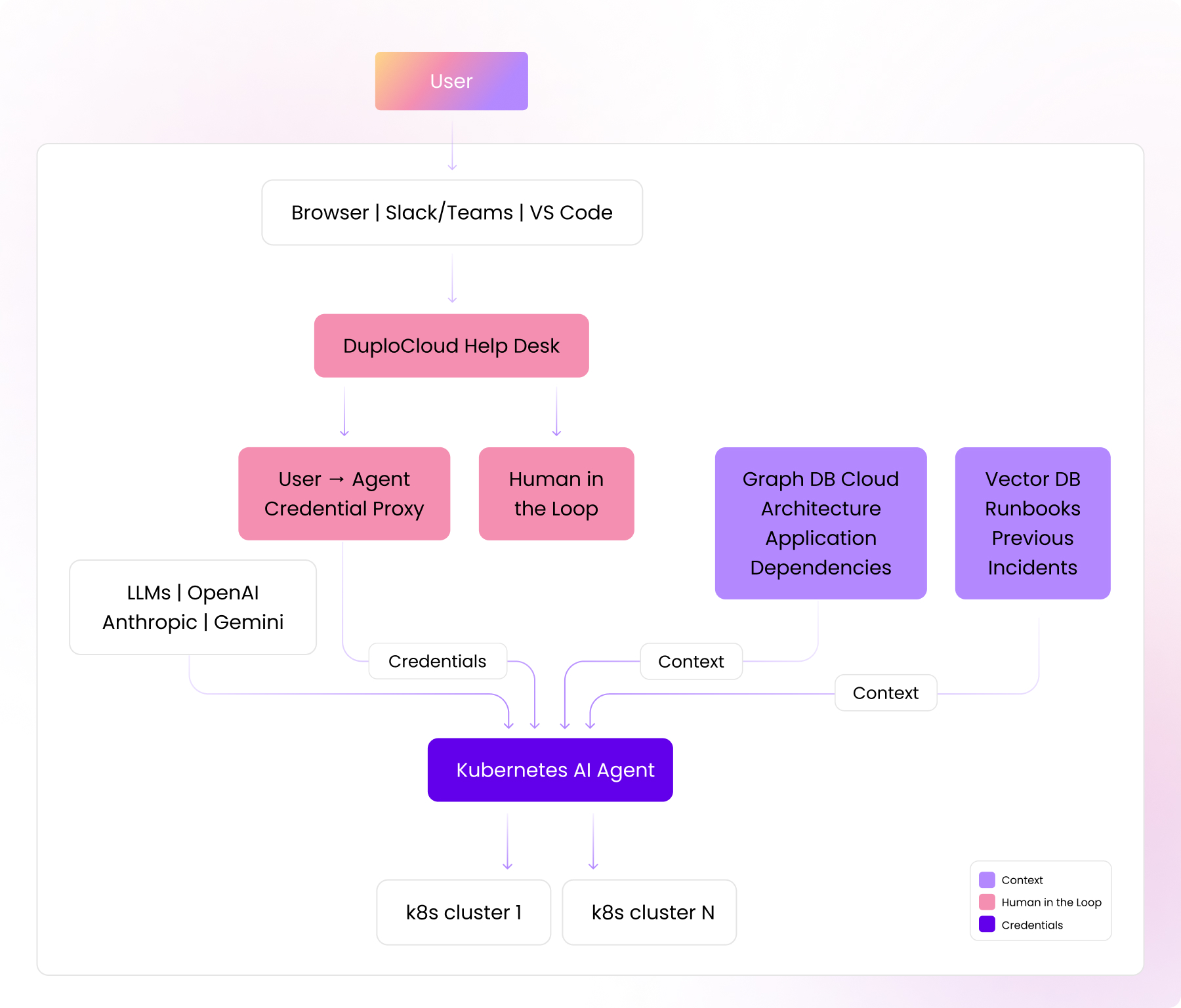
Below is a map of DuploCloud’s Kubernetes AI Agent architecture. For peace of mind, this includes:
- Explicit credential flow
- Context ingestion
- Human-in-the-loop execution.
Our Kubernetes Agent acts as your automated platform engineer. It identifies issues and proposes solutions based on proven runbook patterns. And of course, it integrates your own custom runbooks.
4 Core Capabilities of DuploCloud’s Kubernetes Agent
Our K8s agent comes with four core capabilities:
- Event Correlation. Links pod failures to root causes across logs, metrics, and configs.
- Pattern Recognition. Identify common failure modes from historical incidents.
- Safe Execution. Implement deployment-ready development work and fixes before asking for human approval. Only once approved will the system deploy anything.
- Runbook Automation. Convert your tribal knowledge into executable workflows.
Security and Compliance
Naturally, security and compliance are very important, so we’ve made sure to be upfront about the lengths we’ve gone to make sure every AI agent is as secure and compliant as possible.
Data Handling
When it comes to data, the Agent will manage the following:
- Processing Location: All analysis within your cluster
- Data Retention: Logs retained per your policy
- Audit Trail: Every kubectl command logged with approver
Access Control
We designed our Kubernetes AI Agent to be permissionless and credentialless. This means that when a user interacts with the agent, DuploCloud automatically generates short-lived credentials. These credentials are scoped to the user’s existing access level. The temporary credentials are then passed to the agent behind the scenes and will be used for all Kubernetes actions.
Compliance Alignment
Our Kubernetes Agent is aligned with:
- SOC 2 Type II
- HIPAA
- PCI-DSS
- FedRAMP
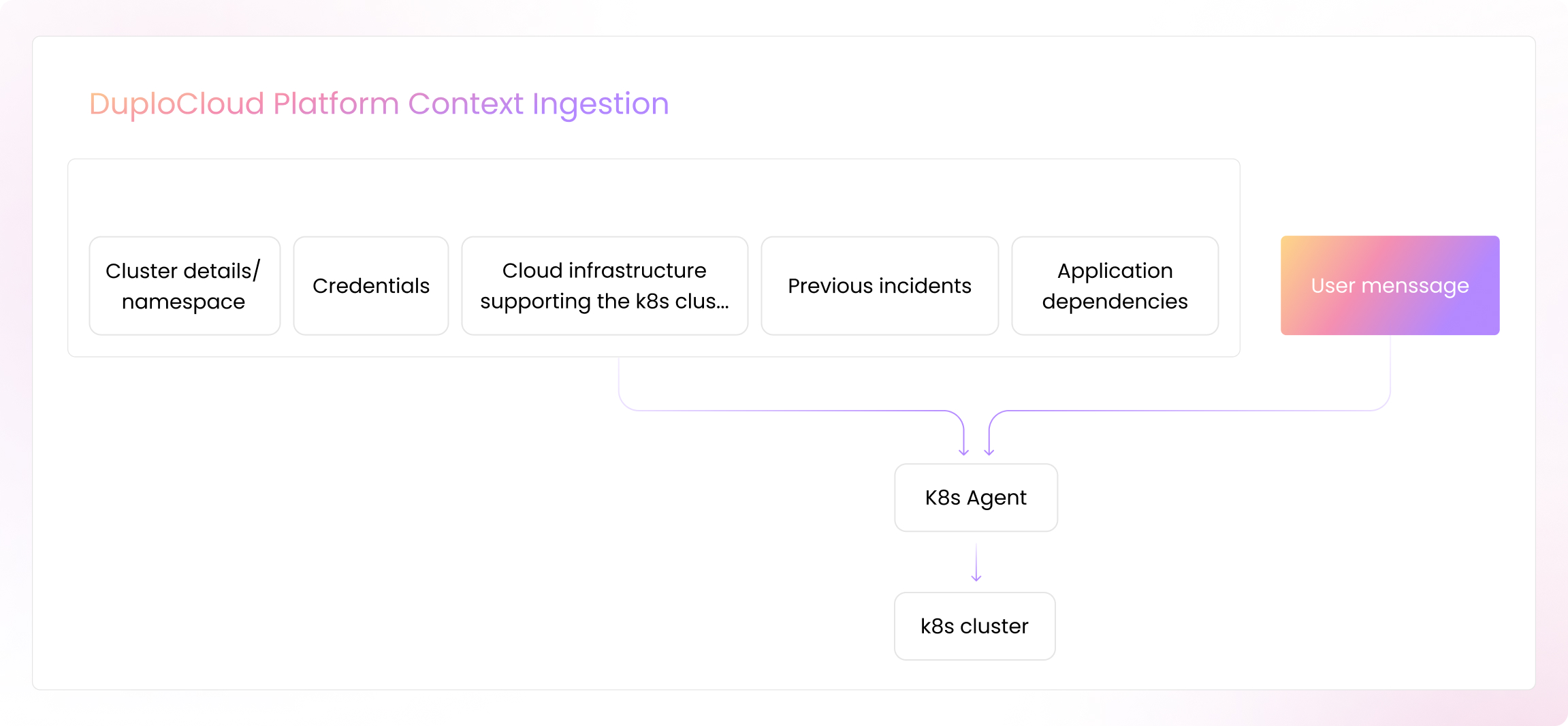
Kubernetes Agent: Technical Architecture
3 Real-World Use Cases
Take a look at some of the real-world use cases our clients have experienced using our Kubernetes Agent.
Use Case 1: Crashlooping Pod Resolution
Trigger: “Investigate crashlooping in payment pods”
Signals checked:
- 3 pods in CrashLoopBackOff
- OOMKilled 5 times in last hour
- Memory usage: 980Mi of 1Gi limit
Proposed action:
kubectl set resources deployment/payment-api -c payment --limits=memory=2Gi
Approval gate: Human reviews the memory increase and approves the change
Result: Pods are stable within 2 minutes of executing the approved memory limit increase
Use Case 2: Node Pressure Response
Trigger: “Node ip-10-0-1-50 showing DiskPressure”
Signals checked:
- Node at 87% disk usage
- 15 pods with large emptyDir volumes
- 3 completed jobs not cleaned up
Proposed action:
kubectl get pods --field-selector spec.nodeName=ip-10-0-1-50 -o json | \
jq -r '.items[] | select(.spec.volumes[]?.emptyDir) | .metadata.name' | \
head -n 5 | xargs kubectl delete pod
Approval gate: Human reviews pod deletion list and approves cleanup
Result: 30GB disk space recovered, node pressure resolved
Use Case 3: Deployment Rollback
Trigger: “High error rate after deployment”
Signals checked:
- Deployment rolled out 15 minutes ago
- Error rate spiked from 0.1% to 50%
- Previous version stable for 7 days
Proposed action:
Proposed Solution:
kubectl rollout undo deployment/user-api
kubectl rollout status deployment/user-api
Approval gate: Human reviews rollback impact and approves reversion
Result: Error rate returned to baseline in 3 minutes
The great thing is that your team can even run kubectl actions using plain English. Your engineers can describe the task, and the AI agent handles the exact commands for you.
-
Integration with Your DevOps Tech Stack
When you’re ready to integrate our Kubernetes Agent with your cluster, there are two clear pathways.
- You can have DuploCloud create the Kubernetes cluster across AWS, Azure, or GCP. Clusters created by the platform are automatically registered and made available to the Kubernetes AI Agent.
- The alternative is that you can import an existing Kubernetes cluster by providing the Kubernetes API endpoint and access token. Once imported, the cluster is registered with DuploCloud and becomes available to the Kubernetes AI Agent.
Both options give the agent direct access to the cluster for monitoring, diagnostics, and automation.
Customer Impact & ROI
A Governance, Risk, and Compliance (GRC) leader recently adopted the Deployment & Environment Agent to simplify their Kubernetes operations. They also hoped to remove bottlenecks during their release process.
Their teams now diagnose issues faster, roll back safely, and launch new services. And they don’t have or even need deep YAML expertise.
Measured outcomes
Since we launched AI agents, which are already deployed across 34 organizations, we’ve seen the following results for our clients:
- Faster recovery: The agent traces failures and enables safe rollbacks, reducing time spent restoring services.
- Quicker launches: Teams can spin up environments and deploy microservices without manual YAML.
- Developer enablement: Junior developers can use safe, self-serve deployments without having to escalate to senior engineers.
- More time for product work: As expected, our agents are actively reducing YAML, DevOps, and CI/CD pipeline toil, allowing teams to focus on shipping new features and developing new products.
Use the DuploCloud Sandbox to test an AI Kubernetes agent
There is no setup, no credentials, and no risk to your production systems.
Our guided tutorial walks you through:- Deploying your first AI agent
- running a task with guardrails
- reviewing execution results
- fixing a failed deployment
- spotting drift in real time
- checking Kubernetes cluster health
You can understand the platform and the AI engineers within minutes.
👉 Start your 14-day free trial: Try Now.
Agent Boundaries and Roadmap
DuploCloud provides AI agents for your core DevOps domains, including Kubernetes, AWS, observability, and CI/CD. Today, our users choose which agent to use for whichever task they’re working on.
And we’re currently actively integrating the A2A protocol so agents can automatically collaborate and pull in capabilities from other agents.
Our Kubernetes AI Agent works well with common Kubernetes architectures, operators, and Helm charts.
However, because the Kubernetes ecosystem is broad, your teams may need to inject company-specific terminology, workflows, and patterns into the agent.
And, as of now, a single request can’t run actions across multiple clusters. For example, queries like “Across prod and non-prod, how many containers are running nginx:1.29.4?” are not supported yet.
The good news is that we’re working on that, too. And we’ve got multi-cluster actions planned for an upcoming release.
Kubernetes Agents Key Takeaway
Kubernetes Agents are transforming cluster operations from manual toil to intelligent automation even as you read this piece. They provide consistent troubleshooting, standardized remediation, and preserved operational knowledge. And you maintain human control over any changes.
For platform teams drowning in kubectl commands, the Kubernetes Agent is providing much-needed support.
Resources