Coding assistants can be useful, but production infrastructure demands more than prompt-based help. DevOps teams need agents that can act on the right commands, within the appropriate boundaries, and with the proper operational context.
You need AI agents that can do more than just generate text, more than just a general-purpose robot to follow orders.
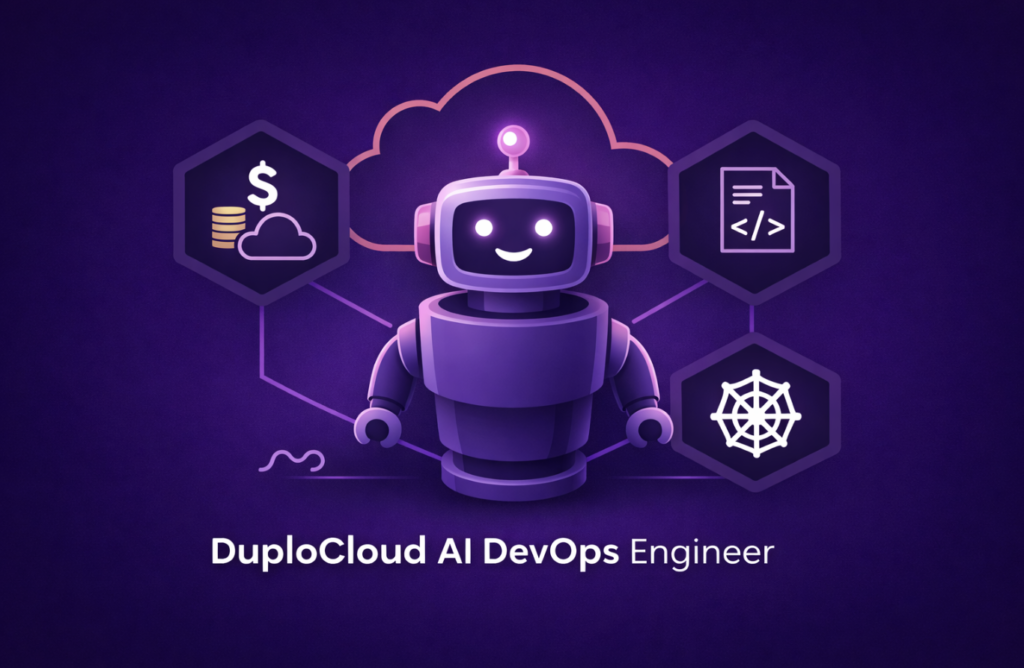
That’s where DuploCloud’s AI DevOps Engineer comes in. A customizable, self-hosted DevOps-focused system built around specialized engineers, agents, and integrations, with AI HelpDesk serving as the human-in-the-loop interface for task execution and collaboration.
In this article, we’ll talk about what skills are, why they matter for cloud operations, and how they fit into the broader platform model. That way, you can evaluate an AI DevOps Engineer as an operational system with the proper scope and guardrails, rather than as a simple coding assistant.
The Skills of an AI DevOps Engineer
In DuploCloud’s AI DevOps Engineer, Skills are essential to the platform. They’re not an afterthought. They don’t get configured as part of some advanced option. Skills are a core part of the architecture, the building blocks that shape what AI engineers can do and how they do it.
Each skill package has a specific capability. This can include anything from operational logic to an automation script. In DuploCloud’s public model, a Skill is a folder containing a SKILL.md file with required metadata and instructions, plus optional supporting assets such as scripts, templates, and reference materials.
Skills can be assigned in three ways:
- Pre-Built Skills: DuploCloud provides pre-built Skills that teams can use to quickly configure engineers.
- External Skills: These are Skills from third-party vendors that can be used directly within the platform.
- Custom Skills: Teams can create their own Skills from scratch to meet organization-specific requirements.
In practice, DuploCloud pairs these capabilities with human-in-the-loop approvals, scoped terminal access, audit trails, and data protection controls such as Duplo Presidio, rather than asking teams to rely on unrestricted autonomous behavior.
The best way to think of AI Skills is as a toolbox an AI Engineer can pull from. When your team asks an engineer to analyze AWS spend, for example, it does not have to rely only on ad hoc prompting. Instead, it can apply an already defined Skill that encodes the logic for that task.
That Skill can define what data to query, what patterns to look for, and what format to use for the output.
So your team can get a more consistent, repeatable result that lines up with how your team already works.
This model is meaningfully different from traditional AI tools that run on general prompts alone. Skills make the behavior of AI systems more explicit, reusable, and inspectable.
Why You Need Skills in DevOps and Cloud Operations
So, what’s the big deal? Why do you need Skills?
Here’s the thing: DevOps and cloud operations work in ways that make structured capabilities especially useful because they address real operational constraints.
Here’s what you’ll get with AI agentic Skills:
Repeatability at scale
Infrastructure teams deal with the same problems over and over: pod failures, cost issues, misconfigurations, and access problems, to name a few. With an encoded Skill, the AI system can reuse the same resolution logic whenever it’s needed.
So you won’t deal with as much variability from treating every task as a blank-slate prompt. New team members, human or AI, can also work from the same packaged operational logic instead of rediscovering it each time.
Operational specificity
Generic models do not know your environment. They don’t know which namespaces matter, which cost centers map to which teams, or which Terraform modules your team prefers. Custom Skills give teams a way to encode that knowledge directly, so the engineer can operate according to your standards.
Safer execution
Cloud operations come with real consequences. DuploCloud’s public model emphasizes scoped access through Providers and Scopes, command approvals inside AI HelpDesk, saved terminal history, and human-in-the-loop oversight. That gives teams a more controlled way to use AI in production environments.
Customer-specific and team-specific workflows
Every infrastructure environment has unique naming conventions, approval processes, compliance requirements, and internal tooling. Custom Skills allow your team to package that institutional knowledge in a way the platform can act on. That’s a major difference between an AI system designed to understand your environment and one that simply gives generic output you still have to translate.
How Skills Apply to the Broader Platform Model
Still, Skills are not standalone capabilities. They exist within a layered system designed to make AI engineers safe, scoped, and operationally useful. You’ll understand them best in the context of the broader platform architecture.
DuploCloud’s AI Suite consists of AI Studio and AI HelpDesk. AI Studio is where specialized agents are built and deployed, while AI HelpDesk is the interface where users open tickets, collaborate with agents, review suggestions, and maintain oversight of actions in production environments.
Within this platform, you can understand the main concepts that define how work gets organized and constrained:
- Skills are units of capability that define tasks an AI Engineer can perform.
- Personas are logical containers that group related Skills by role or function.
- Engineers are the configured operational teammates that combine Personas or Skills with Agents, Providers, and Scopes.
- Providers store credentials for cloud accounts, Kubernetes environments, Git repositories, observability systems, and other connected services.
- Scopes define what resources an Engineer can see and access.
- Projects represent planned work and can optionally use a Scope that is a subset of the Engineer’s full Scope.
- MCP Servers extend access to external systems and tools beyond cloud infrastructure and code repositories.
Layering matters here. An AI Engineer is not just an AI system with access to your cloud. It is a configured operator with defined capabilities, connected systems, limited access, and work that can be organized around a specific objective.
That is, it’s an Engineer equipped with Skills and Personas, powered by Agents, constrained by Scopes, and often working within a Project.
That model is much closer to how experienced infrastructure teams actually work. Senior engineers do not have unrestricted access to every system. Their scope of action depends on role, context, and oversight.
DuploCloud’s AI DevOps Engineer brings that same discipline to agent-based automation.
Skills in the Real World: Practical Use Cases
Now that you understand this architecture in the abstract, it helps to see it in the real world. Here are five scenarios where Skills can make an AI DevOps Engineer genuinely useful:
AWS Cost Analysis
Understanding cost is a major part of cloud operations. The challenge is not just getting spend data, but turning it into useful analysis across accounts and services. An AI engineer equipped with cost analysis Skills can apply the same logic repeatedly for scoped reviews, anomalies, tagging gaps, and recommendations instead of rebuilding that analysis from scratch every time. DuploCloud publicly positions its AI DevOps Engineer around cost, compliance, observability, and infrastructure operations, so this use case fits the platform’s broader direction.
EKS Troubleshooting
Kubernetes troubleshooting is another strong fit. DuploCloud’s public docs list Kubernetes troubleshooting among its pre-built agent examples, and the platform supports Kubernetes providers including EKS, AKS, and GKE. A troubleshooting Skill can encode the diagnostic logic your team wants applied first, making investigations more structured and repeatable.
Customer-Specific Operational Runbooks
Many infrastructure teams support multiple customers or internal business units. Each one has its own requirements. With custom Skills, your team can encode customer-specific workflows such as tagging standards, approval chains, and compliance-driven checks. Any AI Engineer working on a relevant task can then apply those Skills directly instead of inferring the right behavior from scratch.
Infrastructure Migrations
Migrations involve recurring structured tasks such as inventory checks, dependency mapping, configuration validation, and rollback planning. DuploCloud’s public positioning includes migrations as a core AI DevOps Engineer use case, and Projects are designed to organize planned work with defined requirements and optional scoped access.
IaC and Terraform Workflows
DuploCloud already supports Terraform-related workflows across its broader platform, and its AI positioning includes IaC maintenance as a common task area. That makes Skills a useful way to encode module patterns, naming conventions, validation steps, and change-management expectations. Teams can use those Skills within existing Git-based workflows rather than forcing an entirely new provisioning model.
The Difference Between Real Skills and a Coding Copilot
There are still far too many teams that imagine Skills, Personas, and Engineers as mere coding assistants. But there’s a real difference between this AI DevOps system and a coding assistant. With a coding assistant, a developer writes code from a terminal or an IDE. It’s a productivity tool, and its context is the editor and the codebase.
In contrast, DuploCloud’s AI DevOps Engineer is built for a different problem space. It operates within a scoped, multi-system, operations-oriented platform. Its context is a live infrastructure environment with real accounts, real clusters, real cost, and real consequences. Its value lies in supporting operational work within defined boundaries, with structured Skills and human oversight throughout.
That distinction matters when you’re evaluating AI tools for infrastructure. The relevant question isn’t just whether a tool can write a Terraform module. It’s:
“Can it operate safely within our environment?”
“Can it apply our team’s operational knowledge consistently?”
“Can we control its scope of action?”
“Can we trust its behavior?”
DuploCloud’s model of Skills, Personas, Engineers, Providers, and Scopes is built to answer those questions more directly than a generic coding copilot.
Effective AI for DevOps Must Include Skills
In the end, effective AI for DevOps and cloud operations comes from combining capable models with structured operational context. You need defined Skills, scoped execution, role-appropriate Personas, and guardrails that keep behavior within acceptable boundaries.
Skills are one of the mechanisms that make that possible. They package reusable capabilities and operational know-how so the platform can apply them when needed in a more consistent, inspectable way. In DuploCloud’s public model, they are explicit capability packages built around SKILL.md, optional supporting assets, and assignment into Personas and Engineers.
And when you combine Skills with Personas, Engineers, Scopes, and Projects, you get a system that is better suited for real infrastructure work:
- Cost analysis
- Cluster troubleshooting
- Migrations
- IaC workflows
You do not just need the most powerful model. You need structured operational context and agents with the right capabilities, oversight, and access model. DuploCloud’s public documentation consistently frames AI HelpDesk and AI DevOps Engineer around that human-in-the-loop, scoped, operational approach.
Don’t take our word for it. Book a demo and see it in action.