Why are teams abandoning the “hire more DevOps” strategy? Because automation platforms can deliver what manual operations just can’t.
It’s a reality: the DevOps scaling paradox hits every team.
Your engineering team hits these milestones like clockwork:
Year 1: “We’ll handle DevOps ourselves.”
Year 2: “We need our first DevOps hire.”
Year 3: “We need a DevOps team.”
Year 4: “DevOps blocks every initiative.”
What’s happening?
The market creates this paradox: you need DevOps capacity to ship faster. But hiring takes 4-6 months. And infrastructure complexity doubles every year. Your product team ships features daily.
Your DevOps team takes quarters to scale.
This article helps you understand the hidden work that’s slowing your engineering team way down. And we’ve got solutions to speed things up and scale things, way back up.
Key Takeaways
- The majority of DevOps effort happens below the surface. This hidden takes up 60-70% of your team’s capacity and scales faster than you can grow your team.
- Of course, hiring alone can’t keep up with the complexity of infrastructure. Adding DevOps engineers will only increase costs and overhead, but it won’t eliminate the toil you go through during operations.
- But when you can encode your best practices and automate your day-2 operations, your platform can help your small team ship faster, stay compliant, and cut cognitive load. And you won’t have to build or staff a large DevOps organization.
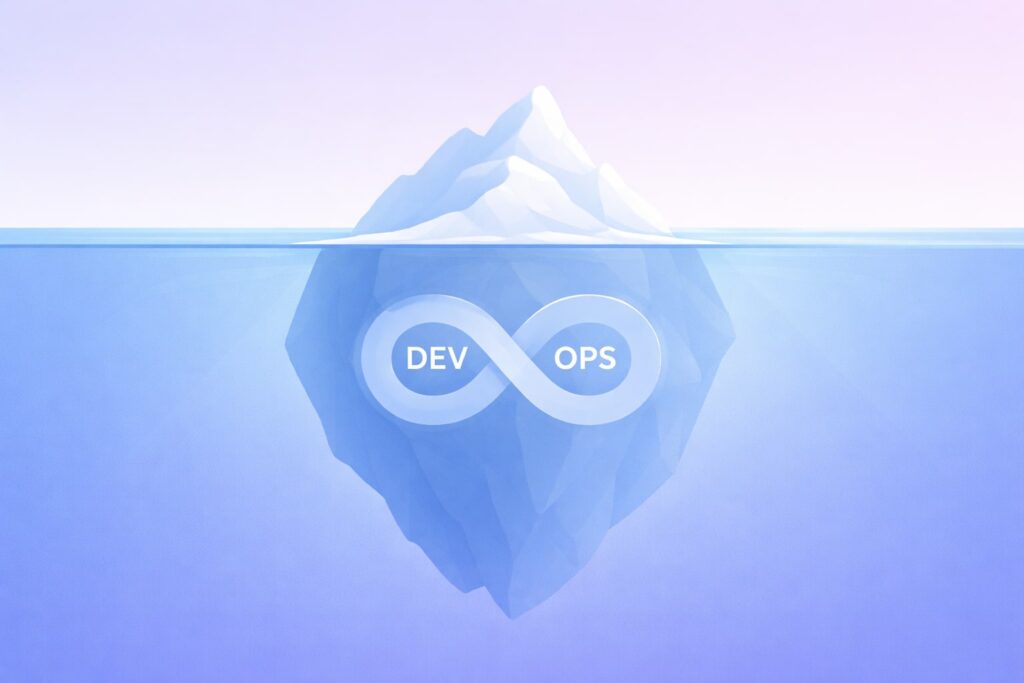
The DevOps Iceberg: Your Teams Only See 30% of the Work
Most engineering leaders track the visible DevOps task. But that’s just the tip of the devops iceberg:
Here’s what you’ll see above the surface (30-40%):
- CI/CD pipelines pump out deployments
- Engineers provision infrastructure
- Dashboards display metrics
- Automation scripts run builds
But here’s what’s happening below the surface (60-70%):
- Engineers hunt down configuration drift across environments
- Teams patches security vulnerabilities every week
- Someone aggregates audit logs for compliance
- Developers debug IAM permissions for hours
- Scripts sync staging and production (when they work)
- Finance asks why cloud costs jumped 40%
- An on-call writes another incident post-mortem
- That one engineer refactors the Terraform modules again
- Certificates expire at 3 am on weekends
- Backup systems fail silently until you need them
This underwater work kills velocity. It consumes 60-70% of DevOps time, grows exponentially, and resists automation through traditional tools.
We’re not just throwing percentages around. We actually tracked time allocation across 50+ DevOps teams. The hidden work consistently ate 60-70% of capacity.
Your Team Can Choose From Three Paths to Scale DevOps
1. Traditional Hiring
Here’s your first option: You post jobs, interview dozens of candidates for months, and pay $180-250K per engineer.
This works when: You have unique infrastructure requirements or operate in regulated industries with specific compliance needs.
But it fails when: You need capacity now, not in 6 months.
2. Consultants and Fractional DevOps
Now, let’s look at your second path: You bring in experts at $200-400/hour for specific projects.
This works when: You need migration expertise or architecture reviews.
But it fails when: You need operational coverage going forward and not just once.
3. DevOps Automation Platforms
And finally, the last option: You adopt platforms that encode DevOps best practices and automate the hidden work.
This option works when: You prioritize velocity over customization (most SaaS under 100 engineers).
But it fails when: You need deep customization for your infrastructure.
AI Transforms Specific DevOps Tasks (Well… Not All of Them)
As you may know, AI excels at pattern-based DevOps work:
Where AI Delivers Impact Today
- Log analysis: AI spots patterns across millions of events in seconds
- Cost optimization: Algorithms recommend right-sizing based on actual usage
- Drift detection: Systems identify configuration inconsistencies automatically
- Runbook automation: AI executes predetermined remediation steps
- Documentation: Tools generate IaC from existing infrastructure
Where Humans Still Win
- Architects design systems and make trade-offs
- Incident commanders coordinate complex outages
- Security teams respond to breaches
- Engineers optimize specific workload performance
- Leaders transform culture and processes
The best teams will combine the two: AI handles the repetitive work while humans focus on strategic decisions.
IRL: How a Fintech Startup Solved Their DevOps Bottleneck
A 40-engineer fintech team we worked with at DuploCloud faced a familiar crisis:
- The SOC2 certification blocked three enterprise deals
- Deployments took two weeks
- They couldn’t wait 4 months for DevOps hires
- Their budget covered one senior engineer at best
Here’s the plan they executed:
Week 1-4: The team adopted DuploCloud’s automation platform. At this time, they migrated their core services.
Week 5-6: The engineers replaced ad-hoc scripts with standardized pipelines.
Week 7-9: The platform implemented automated compliance controls.
Week 10+: The team activated AI-assisted monitoring and remediation.
After 90 days, they took the measure of their success. Here’s what they found:
- Their deployments accelerated from biweekly to daily
- Their MTTR dropped from 4 hours to 45 minutes
- They achieved SOC2 Type I certification
- They saved $200K+ in hiring costs
- The developers stopped debugging the infrastructure
In exchange, they accepted these trade-offs:
- Less customization than they would have gotten with hand-built systems
- They’re dependent on a platform vendor
- There was an initial learning curve for the team
To Adopt an AI Platform… or Not
What should you do? Here’s a decision framework we’ve created for you.
It’s a good idea to adopt automation platforms when:
- DevOps blocks your product velocity every week
- Your compliance requirements accelerate deal cycles
- You spend >$15K/month on DevOps tools
- Your team has fewer than 100 engineers
- You value standardization over customization
Instead, you should build traditional DevOps teams when:
- Your infrastructure requires a unique architecture
- You’ve already invested in custom platforms
- You have strong DevOps leadership in place
- Your systems demand deep customization
Teams Can Transform DevOps from Department to Discipline
The fastest-shipping teams treat DevOps as a shared capability. They don’t isolate it in a department. Automation platforms and AI tools make this shift possible.
Here’s how:
Democratization: Every developer safely manages infrastructure.
Encoded expertise: Best practices ship with every deployment.
Faster feedback: Issues surface and are resolved in minutes, not days.
Reduced cognitive load: Teams focus on product, not plumbing.
This approach doesn’t eliminate DevOps expertise. It amplifies impact. One DevOps engineer with automation delivers what three engineers can do manually.
Engineering Leaders Should Act Now
If you’re ready to make the move to bringing AI DevOps Engineers into your team, here’s your timeline:
Week 1: Audit where your team actually spends time and track the hidden work.
Week 2: Calculate your true DevOps costs: salaries + tools + opportunity cost.
Week 3: Run a pilot on a non-critical service you provide.
Week 4: Measure what matters to your team: MTTR, deployment frequency, and developer satisfaction.
The reality is that the teams solving the DevOps bottleneck don’t have the biggest DevOps departments. Rather, they recognize that operational excellence is now a product decision, not a hiring strategy.
Indeed, modern infrastructure can run itself… if you build it right.
DuploCloud Can Deliver This Transformation
Don’t worry, you’re not alone. DuploCloud is here to help. Our platform provides:
- Complete DevOps automation that handles provisioning, CI/CD, observability, security, and compliance in one platform
- AI DevOps Engineers that execute real operational tasks in your cloud with built-in guardrails
- Fractional DevOps experts who guide architecture, migrations, and provide 24/7 support when automation isn’t enough
Many of our users rely on DuploCloud to achieve PaaS-like simplicity with full AWS, GCP, and Azure control. So you can ship faster without growing operational overhead.
Ready to make the shift to bringing AI DevOps Engineers into your team?
FAQs
Is a DevOps automation platform a replacement for DevOps Engineers?
No way! Automation platforms replace repetitive, procedural work. They don’t replace judgment or expertise. The best teams will still rely on DevOps Engineers for architecture decisions, incident leadership, and performance tuning. All automation does is multiply the impact.
When does a DevOps automation platform not make sense?
If your infrastructure is highly bespoke, deeply regulated, or already built on extensive custom tooling, a platform might just make things more complicated. Teams with mature internal platforms and dedicated DevOps leadership may benefit more from incremental automation.
How is this different from using Terraform, CI/CD tools, and monitoring vendors?
Traditional tools automate individual tasks. Automation platforms coordinate those tools, enforce guardrails, manage drift, and handle compliance and remediation from start to finish. They reduce the operational glue work that teams usually maintain by hand.
What metrics should we use to evaluate success?
Focus on your outcomes, not the tooling activity. Look at:
- Deployment frequency
- Mean time to recovery (MTTR)
- Time to meet compliance requirements
- Developer satisfaction and interruption rate
As you watch those improve without increasing headcount, you’ll know the platform is doing its job.