Agentic DevOps is an approach to cloud operations in which specialized AI agents autonomously handle infrastructure provisioning, deployment, security, compliance, and incident response, coordinating with each other in real time while routing critical decisions through human approval workflows. Unlike traditional DevOps automation, which executes fixed scripts, agentic DevOps systems reason through novel operational conditions, adapt to changing infrastructure state, and collaborate across domains to recommend and execute the best course of action.
Agentic DevOps represents the next evolution of cloud operations, moving beyond automation that executes predefined rules to AI systems that understand context, coordinate across disciplines, and continuously improve how engineering teams manage complex cloud environments. This guide explains what agentic DevOps is, how it differs from traditional DevOps automation and AIOps, and what to look for when evaluating an agentic DevOps platform.
What Is Agentic DevOps?
Traditional DevOps automation operates on fixed logic: if condition A is met, execute script B. That model works well for predictable, isolated tasks. It struggles when a deployment failure touches Kubernetes networking, application performance, and a downstream compliance requirement simultaneously.
Agentic DevOps replaces those fixed scripts with AI agents — software components that perceive their environment, reason through operational conditions, and take goal-directed actions. In a DevOps context, this means agents that can:
- Detect an infrastructure anomaly and correlate it with recent deployment activity
- Determine whether a Kubernetes pod failure is caused by resource limits, a misconfigured health check, or an upstream dependency
- Identify compliance drift and cross-reference it against current security policies before recommending remediation
- Coordinate with other agents to build a complete operational picture before presenting a recommended action
The “agentic” part specifically refers to this reasoning and coordination capability: agents acting with a degree of autonomy toward defined goals, rather than executing instructions step by step.
Traditional DevOps Automation vs. Agentic DevOps
| Capability | Traditional Automation | Agentic DevOps |
|---|---|---|
| Decision logic | Fixed rules, predefined scripts | AI reasoning across live infrastructure state |
| Scope | Single-domain (e.g., CI/CD pipeline only) | Cross-domain (infra + security + compliance + observability) |
| Incident response | Alerts routed to engineers manually | Agents correlate telemetry, identify root cause, surface remediation options |
| Adaptability | Requires manual script updates for new conditions | Agents adapt to novel infrastructure states |
| Collaboration | Siloed tools, separate runbooks | Agents share context and coordinate across domains |
| Human oversight | Ad hoc, with engineers reviewing after the fact | Structured approval workflows before consequential actions |
| Compliance evidence | Manual collection at audit time | Continuous automated evidence collection with full audit trail |
| Operational learning | Static and does not improve over time | Agents improve recommendations based on operational history |
How Agentic DevOps Works: The Architecture
An agentic DevOps system has three layers working together:
1 Specialized Domain Agents
Each agent is responsible for a specific operational domain and holds deep knowledge of it. Rather than a single AI model trying to do everything, each agent is purpose-built for its domain — and collaborates with the others when a problem spans multiple areas.
Infrastructure Agent
Manages cloud resource provisioning, lifecycle, and cost across AWS, Azure, and GCP.
Kubernetes Agent
Monitors cluster health, scales workloads, and resolves pod failures before they impact delivery.
Deployment Agent
Analyzes CI/CD pipelines, manages release risk, and automates rollbacks when issues are detected.
Security Agent
Detects vulnerabilities, validates policies, and flags misconfigurations before they reach production.
Compliance Agent
Monitors against SOC 2, HIPAA, FedRAMP, and PCI-DSS frameworks and collects evidence continuously.
Observability Agent
Analyzes logs, traces, and metrics to surface root causes faster than manual investigation.
Cost Optimization Agent
Identifies underutilized resources and surfaces rightsizing recommendations with cost impact estimates.
Orchestration Agent
Coordinates communication across every domain agent — the connective layer that turns individual signals into a unified recommendation.
2 Orchestration Layer
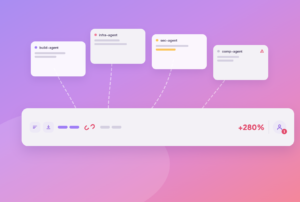
An orchestration agent coordinates communication between domain agents. When a deployment failure, security alert, or compliance drift occurs, the orchestrator determines which agents need to collaborate, sequences their analysis, and synthesizes findings into a recommended action. An orchestration layer that connects Kubernetes agent findings with security agent context with observability agent telemetry produces recommendations no single-domain tool could generate.
3 Human-in-the-Loop Approval Workflows
Agentic DevOps does not mean autonomous execution without oversight. Production-grade platforms route consequential actions — deployments, infrastructure changes, security remediations — through structured approval workflows before execution. Engineers review the agent’s reasoning, approve or modify the proposed action, and maintain a complete audit trail of every decision. This is non-negotiable for enterprise environments operating under compliance frameworks.
Agentic DevOps vs. AIOps vs. DevOps Automation
These terms are often used interchangeably. They are not the same thing.
DevOps Automation
- What it does: Executes predefined workflows — CI/CD pipelines, Terraform plans, Ansible playbooks.
- Key limitation: Cannot reason or adapt outside predefined logic. Breaks when conditions change unexpectedly.
- Example tools: Jenkins, Argo CD, Terraform, Ansible
AIOps
- What it does: Applies ML to operational data to reduce alert noise, detect anomalies, and correlate events across monitoring streams.
- Key limitation: Observability-focused and largely passive — it surfaces insights but rarely takes action, and typically doesn’t span infrastructure domains.
- Example tools: Datadog, Dynatrace, PagerDuty, Moogsoft
Agentic DevOps
- What it does: Deploys reasoning AI agents across infrastructure, security, compliance, and operations — coordinating them to act on behalf of engineering teams with human approval at consequential steps.
- Key limitation: Requires a governance layer and clear human-in-the-loop controls; enterprise adoption is still early-stage.
- Example tools: DuploCloud, Harness AI, Opsera, Microsoft Azure Agentic DevOps
DevOps automation executes. AIOps observes. Agentic DevOps reasons and acts — with human approval at the consequential steps.
The Role of MCP in Agentic DevOps
Model Context Protocol (MCP) has emerged as a key integration standard for agentic DevOps systems. MCP allows AI agents to securely connect to external tools, APIs, and data sources, giving them the context they need to make accurate operational decisions without requiring custom integrations for every tool.
In practice, an agentic DevOps platform using MCP can pull live Kubernetes cluster state, CI/CD pipeline status, security scan results, and compliance posture into a unified agent context. The agent reasons across all of it simultaneously instead of requiring an engineer to manually correlate findings across five separate dashboards.
DuploCloud integrates into existing toolchains via API and MCP, which means agents operate on the same live infrastructure state your existing Jenkins, Argo, Datadog, or PagerDuty instances are seeing.
Build vs. Buy: AI Frameworks vs. Agentic DevOps Platforms
Engineering teams exploring agentic DevOps often encounter two paths:
Build with a Multi-Agent Framework
Tools like LangGraph, CrewAI, and AutoGen provide scaffolding to assemble custom AI agents. Flexible and powerful, but require significant engineering investment: defining agent roles, building tool integrations, designing orchestration logic, and maintaining the system as infrastructure evolves.
Best for ML/AI teams
Deploy an Agentic DevOps Platform
A purpose-built platform arrives with pre-built agents, pre-integrated toolchain connectors, orchestration logic, and governance workflows already in place. Engineering teams configure and extend rather than build from scratch.
Best for DevOps teams
| Build with Frameworks (LangGraph / CrewAI / AutoGen) |
Deploy a Platform (DuploCloud) |
|
|---|---|---|
| Time to first agent | Weeks to months | Days |
| Domain knowledge required | High — you define all agent behavior | Low — pre-built agents encode best practices |
| Toolchain integrations | Custom-built per integration | Pre-built (Jenkins, Argo, Datadog, PagerDuty, etc.) |
| Compliance and governance | DIY approval workflows and audit trails | Built-in RBAC, approval workflows, audit logging |
| Customization | Unlimited, with full control over agent logic | High, custom agents for team-specific workflows |
| Maintenance overhead | High and evolves with infrastructure and LLM changes | Managed by platform vendor |
Many enterprise teams are discovering that frameworks like LangGraph and CrewAI are the right tools for the 20–30% of DevOps workflows truly unique to their team — and that a platform like DuploCloud handles the 70% of common DevOps work that every team faces the same way.
Human-in-the-Loop: Why Governance Is Non-Negotiable
The enterprise hesitation around agentic DevOps is legitimate: autonomous AI systems making infrastructure changes without oversight create risk. Production-grade agentic DevOps platforms address this through four structured controls:
Role-Based Access Control (RBAC)
Defines which agents can act in which environments. A Kubernetes agent can recommend scaling changes in staging autonomously but requires engineer approval before touching production.
Approval Workflows
Present the agent’s recommended action, along with its full reasoning chain, to the relevant engineer before execution. The engineer can approve, modify, or reject.
Audit Trails
Log every agent action, every approval, and every rejection with timestamps and actor identity. This is what makes agentic DevOps viable for organizations operating under SOC 2, HIPAA, FedRAMP, or PCI-DSS requirements.
Policy Enforcement
Prevents agents from acting outside defined guardrails. An agent cannot provision a resource type not in the approved catalog or execute a change that would violate a compliance boundary.
Treat governance as a first-order requirement, not a feature to be added later.
How DuploCloud Implements Agentic DevOps
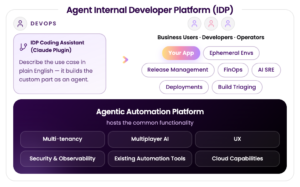
DuploCloud provides pre-built AI agents for the full DevOps lifecycle: infrastructure provisioning, Kubernetes management, CI/CD optimization, security remediation, compliance validation, observability analysis, and cost optimization — all connected through an orchestration layer that coordinates their findings before surfacing recommendations.
For the remaining 20–30% of workflows specific to a team’s environment, DuploCloud’s AI Coding Assistant lets engineers define the input, output, and workflow logic. It scans the platform, builds only the custom logic needed, and deploys it as a live agent — without requiring the team to build orchestration infrastructure, toolchain integrations, or governance workflows from scratch.
DuploCloud integrates with existing toolchains via API and MCP, including Jenkins, Argo CD, Datadog, PagerDuty, and GitHub Actions, and supports AWS, Azure, and GCP.
Agentic DevOps Use Cases
Incident Response
When a production alert fires, agents correlate log telemetry, recent deployment activity, Kubernetes pod state, and network configuration simultaneously. Rather than an engineer spending 45 minutes triaging across five dashboards, the system surfaces a probable root cause with supporting evidence and a recommended remediation — waiting for approval before execution.
Compliance Automation
Compliance agents continuously validate infrastructure configuration against SOC 2, HIPAA, FedRAMP, and PCI-DSS requirements. When drift is detected, the agent identifies the specific resource, the violated control, and the remediation path, and collects evidence automatically. At audit time, evidence is already assembled.
Kubernetes Operations
Kubernetes agents monitor cluster health, recommend scaling decisions based on observed traffic patterns, detect misconfigured workloads, and flag resources consuming more than their reserved capacity — surfacing rightsizing recommendations with cost impact estimates.
Security Remediation
Security agents continuously scan for vulnerabilities, misconfigurations, and policy violations across cloud resources. When a finding requires remediation, the agent cross-references infrastructure context (is this resource in a production environment? does it handle PII?) before assigning severity and recommending a remediation path.
CI/CD Optimization
Deployment agents analyze pipeline performance, identify flaky tests, flag high-risk releases based on change scope, and recommend deployment windows — reducing release risk without slowing delivery velocity.
Frequently Asked Questions
What is agentic DevOps?
Agentic DevOps is an approach to cloud operations in which AI agents autonomously handle specific DevOps domains — including infrastructure, Kubernetes, security, compliance, and observability — while coordinating with each other through an orchestration layer. Unlike traditional automation, agentic DevOps systems reason through novel operational conditions and adapt their recommendations based on live infrastructure state. Human approval workflows ensure engineers remain in control of consequential actions.
How is agentic DevOps different from traditional DevOps automation?
Traditional DevOps automation executes fixed scripts when predefined conditions are met. Agentic DevOps introduces AI agents capable of reasoning through novel conditions, collaborating across domains, and adapting to changing infrastructure without requiring manual script updates for every new scenario. The primary difference is adaptability and cross-domain coordination.
What is a multi-agent system in the context of DevOps?
A multi-agent DevOps system is a collection of specialized AI agents — each focused on a specific operational domain (infrastructure, Kubernetes, security, compliance, observability) — that share context and coordinate through an orchestration layer. This coordination allows the system to address complex operational events that span multiple domains simultaneously.
What is the difference between agentic DevOps and AIOps?
AIOps primarily applies machine learning to observability data to reduce alert noise and surface anomalies. It is largely passive: it surfaces insights but rarely takes action. Agentic DevOps goes further — agents reason across operational domains, coordinate with each other, and execute approved actions. Agentic DevOps can include AIOps capabilities as part of its observability agent, but AIOps alone is not agentic DevOps.
What is human-in-the-loop in agentic DevOps?
Human-in-the-loop means that AI agents present their recommended actions, along with their reasoning, to an engineer for approval before execution. This is enforced through approval workflows, role-based access controls, and audit trails. It ensures that consequential infrastructure changes, security remediations, and compliance actions are always reviewed by a human before they run.
How does agentic DevOps handle compliance?
Compliance agents in an agentic DevOps system continuously monitor infrastructure configuration against regulatory requirements including SOC 2, HIPAA, FedRAMP, and PCI-DSS. When drift is detected, the agent identifies the specific violation, the affected resource, and the remediation path, and routes it for approval. Evidence is collected automatically throughout, building the audit trail incrementally rather than at review time.
What is MCP and why does it matter for agentic DevOps?
Model Context Protocol (MCP) is an integration standard that allows AI agents to securely connect to external tools and data sources. In a DevOps context, MCP enables agents to pull live infrastructure state, pipeline status, security findings, and compliance posture into a unified context — so agents reason across real operational data rather than stale snapshots. Platforms that support MCP integrate more cleanly with existing toolchains.
What multi-agent frameworks are used to build agentic DevOps systems?
The most common multi-agent frameworks for building custom DevOps agents are LangGraph, CrewAI, and AutoGen. These provide agent scaffolding and orchestration logic for teams building custom AI workflows. Organizations that need full customization may use these frameworks for their unique workflows, while deploying a purpose-built platform like DuploCloud for the common 70% of DevOps operations.
Which cloud providers support agentic DevOps?
Major cloud providers including AWS and Microsoft Azure have introduced agentic DevOps capabilities (AWS DevOps Agent, Azure Agentic DevOps). Third-party platforms like DuploCloud provide agentic DevOps across AWS, Azure, and GCP with the advantage of a cloud-agnostic orchestration layer and pre-built compliance frameworks not tied to a single hyperscaler.
Is agentic DevOps suitable for regulated industries?
Yes, when implemented with proper governance. Regulated industries (healthcare, financial services, government, SaaS with enterprise contracts) are well-suited for agentic DevOps because compliance evidence collection and policy enforcement can be automated. The critical requirement is a platform with built-in RBAC, approval workflows, and audit trails, plus native support for relevant frameworks like SOC 2, HIPAA, FedRAMP, and PCI-DSS.
How long does it take to implement an agentic DevOps platform?
It depends on the implementation approach. Building a custom multi-agent system with frameworks like LangGraph or CrewAI typically requires several months of engineering investment. Deploying a purpose-built agentic DevOps platform like DuploCloud can bring pre-built agents online within days, with custom agent development for team-specific workflows added incrementally.
Conclusion
Agentic DevOps is not a replacement for DevOps engineers. It is the infrastructure that multiplies what they can accomplish. As cloud environments grow in complexity and the volume of operational events outpaces what any team can manually manage, AI agents that reason across domains, coordinate findings, and execute approved actions represent the practical path forward.
The organizations moving first on agentic DevOps are those with strong DevOps teams already — teams that understand their operational challenges well enough to know which workflows to automate and which to keep under close human control. The platforms that serve them best combine pre-built coverage for common operations with the flexibility to build custom agents for what makes each team’s environment unique.