The calendar invite appears. “Quick chat?” It’s your senior DevOps engineer. The one who knows why the production database has that one configuration flag nobody else has touched. The one who gets paged first, because they’re the only person who can trace an incident to its root cause in under an hour. The one the rest of engineering routes questions through, because it’s faster than opening a ticket.
You accept the invite. Before the call even starts, you’re already doing the math.
Who else knows how the deployment pipeline actually works? Not the diagram version. The real one, with two years of workarounds baked in. Who knows the three-step rollback sequence that doesn’t trigger a cascade? Who knows why that one service in staging behaves differently from production, in a way that never quite made it into a doc?
If you’re honest, the answer is probably: nobody. Not completely. Not the way he does.
The Risk Isn’t Losing the Person. It’s Losing What They Knew.
At most lean DevOps teams, one person holds a disproportionate share of how everything actually works. Not because of bad planning. Because that’s how operational knowledge accumulates on small, fast-moving teams. Every incident, every workaround, every “I’ve seen this before” gets absorbed by whoever’s closest to the infrastructure. Over time, that person becomes the system.
Here’s the uncomfortable part: most of that knowledge was never written down, because there was never time to write it down. It lives in closed browser tabs. In Slack DMs nobody can search under pressure. In Jira tickets that capture the resolution, not the three hours of investigation that got you there.
When your best DevOps engineer leaves, they don’t take their laptop. They take the organizational intelligence your team has been accumulating, unintentionally, for years.
Why the Obvious Fix Doesn’t Work
The instinct is to solve this with documentation. Schedule a knowledge transfer. Build a runbook. Make them write it all down before their last day.
This almost never works, and not for a lack of effort.
The knowledge that actually matters, the investigative logic, the pattern recognition, the “I’ve seen this before and here’s what it usually means,” is hard to document because it’s tacit. It’s built from hundreds of incidents, not written as a linear procedure that fits neatly into Confluence.
What gets documented in a knowledge transfer is the easy 20%: how to access the dashboard, the deployment steps, the on-call rotation. What doesn’t get documented is the hard 80%: how they actually think through an incident, what they check first and why, the pattern in this one service that predicts most of its alerts.
The Jira ticket says “resolved: config drift in service mesh.” It doesn’t say you spent two hours chasing a red herring in the database layer before someone remembered seeing this in staging three months ago. It doesn’t say the alert that matters is the second one, not the first. It doesn’t say any of the things that would help the next engineer close this in twenty minutes instead of two hours.
What This Actually Costs
The visible cost is easy to budget for: an open headcount, a recruiting timeline, ramp time.
The invisible cost is bigger.
Incidents take longer
When the engineer who solved this before isn’t around, the next incident starts from zero. Clearstep ran into this on their previous cloud platform: production outages, like too many simultaneous database connections, meant filing a ticket and waiting, with no way to draw on anyone’s prior diagnosis of the same failure.
100+ hours saved in Kubernetes cluster upgrades, across DuploCloud’s customer base
Onboarding grinds
A new hire joining a team where knowledge lives in people’s heads typically takes four to six months to become genuinely effective. Clearstep scaled its healthcare AI infrastructure without ever hiring a dedicated DevOps team, knowledge was in the system from day one, not locked in one person’s head waiting to be transferred.
4x increase in infrastructure-as-code adoption with no added headcount
The same problem gets solved twice
Without a system that captures the investigative path, different engineers on different shifts solve the same incident from scratch. Tyfone avoided exactly this by standardizing the process instead of re-solving it per customer, across 42 successful environment migrations.
60% faster provisioning, 30–40% more reclaimed DevOps capacity — Tyfone
Your best people become a search engine
When institutional knowledge lives in people instead of systems, your most experienced engineers spend a disproportionate share of their time answering questions a well-built knowledge system would answer on its own. That’s expensive time, pointed at the wrong problem.
10x gain in developer productivity with self-service infrastructure
The Pattern Nobody Talks About: How AI Agents for DevOps Made This Worse Before It Got Better
Here’s a dynamic most engineering teams have noticed but few have said out loud.
As engineers adopted AI tools for DevOps, Claude, Copilot, GPT, individual productivity jumped. An engineer running a local AI session can diagnose an incident faster, test more hypotheses, and get to root cause quicker than they could alone.
But those sessions are single-player and temporary. Close the tab, and it’s gone. The reasoning, the hypotheses that got ruled out, the exact command that worked: gone.
The result is a strange paradox. AI made individual engineers sharper while making team knowledge more fragmented. Every engineer is getting smarter on their own machine. The organization isn’t getting smarter at all.
That’s the gap that actually matters for startup teams. Not whether your engineers have good tools, but whether the intelligence those tools produce compounds across the team, or evaporates the moment the session ends.
What It Looks Like When the System Actually Works
Picture the same departure. Except this time, your infrastructure knowledge lives in a system, not in a person.
When your senior engineer leaves, you’re not running an extraction sprint against the clock. The investigative history of every incident they’ve touched is already in the system: not just what got resolved, but what was tried, what failed, what the hypothesis was at each step. The patterns they noticed about specific services. The workarounds they built. The context that used to live only in their head.
When the next engineer hits a similar incident, they’re not starting cold. They can see every prior investigation into this class of problem. The AI working alongside them already knows this alert pattern usually traces back to one specific service, because the last three times it happened, that’s exactly where it led.
When the new hire starts, onboarding isn’t six months of slow osmosis. It’s access to a body of operational knowledge the team has been building since before they showed up.
The knowledge doesn’t leave when the engineer does, because it was never stored only in the engineer.
The architectural difference is this: knowledge gets captured as a natural byproduct of doing the work, not as a separate documentation task engineers have to remember under deadline pressure. Every investigation, every incident, every infrastructure decision leaves a record automatically: the reasoning, not just the resolution.
Where to Start, Before the Next Departure
You don’t need to solve this before the next person leaves. Three things to do now:
1 Map your single points of knowledge
Which incidents always route to the same one or two engineers? Which systems does only one person actually understand? Those are your highest-risk spots, and your highest-value targets for capture.
2 Change what your incident tickets capture
A ticket with only the resolution is a missed opportunity. Set a lightweight standard: what got checked, what got ruled out, what the decisive finding was. It doesn’t need to be comprehensive. It needs to be enough that the next engineer can pick up where the last one left off.
3 Check whether your toolstack accumulates knowledge or forgets it
Most DevOps tooling is great at executing work and bad at preserving the reasoning behind it. Some teams solve this by hiring their way out of it. Others look at devops managed services or AI-native platforms built to treat knowledge capture as infrastructure, not an afterthought. If your operational intelligence resets every time a session ends or a ticket closes, the problem keeps coming back, no matter how good your offboarding docs are.
The Structural Question Underneath All of This
The engineer who just left is a symptom, not the disease.
The disease is an infrastructure operating model where organizational intelligence lives in people instead of systems. Where the knowledge that keeps things running sits in the memory of whoever happens to be available, instead of in a shared layer everyone can draw from, one that compounds over time.
Fixing that doesn’t require a bigger team. It requires a different architecture for how your team’s knowledge gets captured, stored, and handed to the engineers, and the AI systems, doing the work.
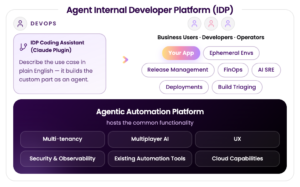
DuploCloud is an AI DevOps platform built on the premise that this architecture matters as much as the individual tools your engineers use. Every investigation, every incident, every infrastructure decision leaves a record the whole team can build on. Shared context. Persistent memory. Knowledge that compounds instead of evaporating. The knowledge is already in the system. Let’s make the handoff smooth.
Ensure your infrastructure isn’t impacted by a change. Let’s discuss how an AI DevOps Platform can help.