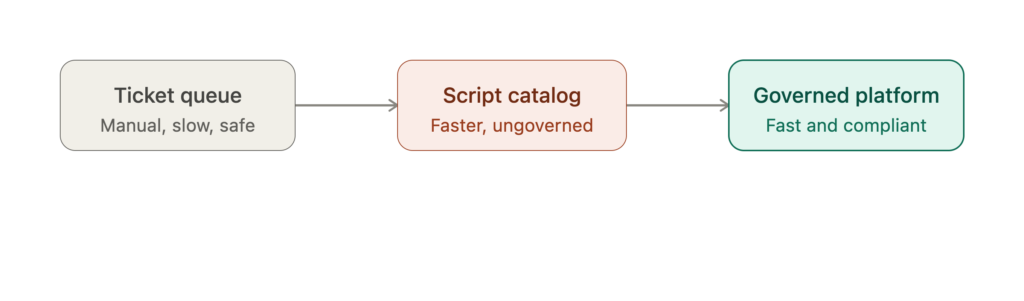
Developer self-service was supposed to end the ticket queue. Platform engineering teams would build internal developer platforms (IDPs), and engineers would provision their own infrastructure without waiting on anyone. That was the pitch.
In reality, most organizations ended up with a catalog of scripts behind a friendly portal. Useful, sure. But nowhere near the governed, compliant system they set out to build. DuploCloud takes a different approach: a low-code devops platform including managed services that delivers policy controls and compliance automation built into the foundation, not bolted on after the fact.
This article covers what safe developer self-service actually requires, why the first wave of platform engineering fell short, and how to build something your team can trust without babysitting it.
What Is Developer Self-Service in DevOps?
Developer self-service gives engineers the autonomy to provision infrastructure, deploy applications, and manage environments without filing a ticket and waiting on a centralized team. Instead of waiting days for someone to run a Terraform module, you click a button or run a command and get what you need.
The appeal is obvious: faster deploys, fewer bottlenecks, engineers who can experiment and ship without waiting in line. But here’s the part most rollouts miss:
Give developers unrestricted access and you get configuration drift, security gaps, compliance violations, and cloud bills nobody can explain. The real challenge was never giving developers access. It’s giving them access with controls that enforce your organization’s policies automatically, every time, without anyone having to remember to check.
Why Traditional Platform Engineering Approaches Fall Short
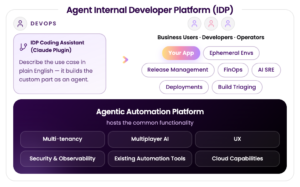
The vision behind platform engineering was compelling: a governed layer where developers request resources through a portal, and the platform handles provisioning, security, compliance, and observability behind the scenes.
The reason most efforts stalled is structural, not a matter of effort. Building an as-a-service platform is a hard distributed systems problem: shared state management, centralized context across environments, role-based access control, audit trails, deterministic execution with SLAs, fault handling and retries, secrets management, and coordination across dozens of engineers and systems.
Most platform engineers come from an operations background: great at running infrastructure, not trained to build multi-tenant distributed services. And an IDP generates no direct revenue, so its budget stays thin. You can’t staff a multi-year systems software effort on a cost-center budget. Renaming the team doesn’t change its skill set.
The Script Catalog Trap
Falling back to “Infrastructure as Code with a new label” wasn’t a failure of effort. It was the most that could realistically get built under those constraints.
Put a self-service skin over a pile of scripts and you’ve built maybe 10% of an IDP’s charter. The UX looks like a platform. Everything behind it is still brittle.
A developer clicks “create service,” a Terraform module runs, and then drift happens. Configurations change. Compliance requirements evolve. Your team ends up right back in the ticket queue, triaging issues the “self-service” layer was never built to handle.
What Safe DevOps Self-Service Actually Requires
Safe self-service isn’t about restricting what developers can do. It’s about encoding your security policies, compliance requirements, and operational standards into the platform itself, so engineers move fast without accidentally creating a mess someone else has to clean up.
Policy Controls and Guardrails
Every self-service action passes through automated policy checks before execution. Try to create an unencrypted database or an oversized instance with no cost tag, and the platform blocks it immediately, not during next quarter’s audit.
Enforced automatically
RBAC That Actually Scales
Real RBAC goes past simple read/write permissions. You need environment-level controls between dev, staging, and production, team boundaries that prevent cross-team edits, and approval workflows for anything high-risk.
Multi-tenant by default
Compliance Automation
Compliance can’t be bolted on after the workflow is built. A genuine compliance automation platform applies the right encryption, logging, and network segmentation the moment a service is created, whether you’re running SOC 2, PCI DSS, GDPR, or HIPAA compliant cloud hosting.
No audit scramble
This is the difference between provisioning that happens to be compliant and provisioning that’s compliant because it structurally can’t be anything else. When compliance is enforced by default, you stop scrambling to remediate findings after the fact and start generating audit evidence as a side effect of normal operations.
See these guardrails running before you commit to anything. Try the DuploCloud AI Sandbox free and provision your first governed environment in minutes.
How Low-Code DevOps Platforms Enable Safe Self-Service
The barrier to real platform engineering was always the distributed systems layer underneath it. Low-code DevOps platforms invert the build order. Instead of starting from scripts and hoping a platform eventually materializes around them, you start with a ready-made, extensible foundation.
With a low-code foundation, the multi-tenant runtime, RBAC, secrets management, audit trails, deterministic execution, retries, cost management, and analytics all come pre-built. Access control and policy enforcement run on every action automatically. You’re not writing custom webhook integrations or hand-rolling a policy engine. The guardrails are structural, not procedural, which is the real difference between “self-service with guardrails” and “self-service where you hope everyone reads the wiki.”
Deterministic execution matters here too. The same request should produce the same result every time. When something fails, the platform retries according to defined policy. When drift occurs, it gets detected and, ideally, remediated automatically. Script catalogs can’t do this. They execute and hope for the best.
Step-by-Step Guide to Building Safe Self-Service DevOps
Building safe self-service starts with understanding what your organization actually needs, not what a vendor whitepaper says you need. Here’s a practical sequence based on what works in production.
1 Assess your current state
Audit existing workflows before adding self-service capabilities. Where do developers wait longest? Which requests generate the most tickets? What compliance requirements apply? This tells you where self-service adds the most value and where guardrails matter most.
2 Define your policy framework
Document the rules governing your infrastructure in a testable format: security requirements, cost limits, compliance controls, naming conventions. These become the guardrails your platform enforces automatically. Start with encryption and access controls, then expand to cost governance once the foundation holds.
3 Choose a platform that handles the hard parts
Avoid the DIY trap: you need a platform that already solves shared state, RBAC, audit trails, fault handling, and deterministic execution. Requiring your team to build that governance layer from scratch is exactly what stalled platform engineering the first time around.
4 Start with a pilot team
Roll out self-service to one team first. Let them provision, deploy, and stress-test the guardrails. Gather feedback on what creates friction. Adjust policy before expanding further.
5 Monitor and iterate
Track adoption: how many requests go through self-service versus tickets, how often policy checks catch non-compliant configs, how fast developers actually get what they need. Use it to refine policy and expand coverage.
Key Components of a Safe Self-Service DevOps Platform
Infrastructure Provisioning
Compute, storage, databases, Kubernetes clusters, all requestable through one interface, with every request passing automated policy checks before resources get created.
Environment Management
Creating, cloning, and tearing down environments should be self-service. Dev, staging, and production each get their own policy profile, enforced automatically. Ephemeral test environments clean up on their own.
CI/CD Pipeline Integration
Developers configure pipelines, trigger deployments, and promote changes across environments without DevOps intervention, while the platform enforces approval gates and security scans at each stage.
Observability and Audit Trails
Every action logs who did what, when, and with what outcome. When something drifts from approved configuration, alerts fire automatically instead of waiting for someone to notice.
Secrets and Credential Management
Built into the platform, not bolted on. Developers create and rotate secrets through self-service workflows, with access controls that block unauthorized retrieval and audit trails that log every access.
Script Catalog vs. Governed Self-Service Platform
| Capability | Script Catalog | Governed Platform |
|---|---|---|
| Policy enforcement | ❌ Manual review | ✅ Automatic, pre-execution |
| RBAC across environments | ❌ Ad hoc | ✅ Built-in, multi-tenant |
| Drift detection | ❌ None | ✅ Continuous, auto-remediated |
| Compliance evidence | ❌ Collected at audit time | ✅ Generated continuously |
| Execution | ❌ Fire-and-forget | ✅ Deterministic, with SLAs |
Common Mistakes to Avoid When Implementing Self-Service DevOps
Building the governance layer from scratch
Every team thinks their requirements are unique enough to justify a custom-built governance system. In practice, 80-90% of what you need already exists in mature platforms. Building it yourself takes years and headcount most organizations can’t sustain.
The trap that stalls platform engineering
Starting with enforcement, not education
Strict policy enforcement without helping teams understand the rules creates friction and workarounds. Start policies in audit mode, log violations without blocking, then move to enforcement once everyone understands what compliance actually requires.
Ignoring drift detection
Self-service that doesn’t detect and remediate drift creates false confidence. Manual console edits and emergency fixes let your actual infrastructure diverge quietly from your intended state.
Overcomplicating the initial rollout
Trying to automate everything at once overwhelms teams and delays value. Start with the workflows generating the most tickets. Expand incrementally based on what’s actually working.
How DuploCloud Delivers Safe Developer Self-Service
DuploCloud approaches self-service differently than script catalogs or DIY platform engineering. It’s a genuine AI-native DevOps platform built for multi-tenant automation with compliance embedded in the foundation, not layered on top.
The platform automates infrastructure provisioning across AWS, Azure, and GCP with security controls mapped to SOC 2, HIPAA, PCI DSS, and GDPR. Developers get self-service access to create environments, deploy applications, and manage resources, while the platform enforces RBAC, generates audit trails, and maintains compliance in the background. If you’re comparing options, our breakdown of cloud compliance automation tools is a fair place to start.
On top of that foundation, operators can extend the platform with skills: modular, reusable packages of automation logic that teach the AI agents how to handle a specific task or workflow unique to your organization, without writing it from scratch. These skills run inside the same multiplayer architecture Venkat Thiruvengadam, DuploCloud’s founder and CEO, wrote about in the AI-native DevOps series. AI agents operate with human-in-the-loop oversight, turning natural language requests into safe, auditable infrastructure actions.
See DuploCloud in action. Try the Sandbox for free and provision your first governed environment in minutes.
FAQs About Building Safe DevOps Self-Service in 2026
What’s the difference between developer self-service and traditional DevOps automation?
Self-service gives engineers direct access to provision and manage infrastructure without filing a ticket. Traditional automation still routes through a centralized team to trigger and manage workflows. DuploCloud enables true self-service with policy enforcement built in, so you keep governance without the bottleneck.
How do guardrails work in a low-code DevOps platform?
Guardrails are automated policy checks that evaluate every self-service request before execution, verifying that resources comply with security policy, cost limits, and compliance requirements. DuploCloud ships with pre-configured guardrails for standards like SOC 2 and HIPAA, plus the ability to define custom policy specific to your organization.
Does DuploCloud host my infrastructure, or does it stay in my environment?
Your infrastructure stays exactly where it is. DuploCloud deploys into your own AWS, Azure, or GCP account and operates there, so nothing runs in a shared external environment DuploCloud controls. You keep full ownership of your data and cloud footprint while the platform handles provisioning, RBAC, and compliance automation on top of it.
Can self-service DevOps maintain compliance with SOC 2 and HIPAA?
Yes, when the platform embeds compliance controls into every provisioning action. DuploCloud applies required encryption, access controls, logging, and network configuration automatically, and generates audit trails and evidence collection that make audits faster and more predictable.
What skills does my team need to implement safe self-service DevOps?
- With a low-code platform: your team doesn’t need distributed systems expertise to build a governed self-service layer. The platform handles RBAC, audit trails, policy enforcement, and compliance automation out of the box.
- If you’re short-staffed: pairing the platform with devops managed services covers the gap without a full-time hire. Either way, your team’s real job is defining policy and building the 10-20% specific to your business.
How do I prevent developers from creating security vulnerabilities through self-service?
Implement policy-as-code guardrails that block non-compliant configurations before they reach production. DuploCloud enforces security policy at the provisioning layer, so developers can’t accidentally spin up a public S3 bucket, an unencrypted database, or an overly permissive network rule. Violations get caught immediately, not during a quarterly audit.
What’s the ROI of a low-code DevOps self-service platform?
Organizations using DuploCloud report deployment times cut by a factor of ten and cloud costs down significantly. The ROI comes from eliminating DevOps bottlenecks, reducing compliance overhead, preventing costly security incidents, and freeing engineering time from infrastructure busywork to focus on product.